The Mysterious Case of N/A: Unlocking the Secret Code That’s Everywhere!
The Mysterious Case of N/A: Unlocking the Secret Code That’s Everywhere!
Have you ever been filling out a form, maybe for school, or a new club, and you see two curious letters staring back at you? Two letters separated by a tiny slash, looking like a secret code: N/A! Or perhaps you’ve seen it in a report, a game score, or even a mystery document online. What does it mean? Why is it there? Today, we’re going on an exciting adventure, like super-sleuth reporters, to uncover the thrilling truth behind this simple yet powerful abbreviation. Get ready to have your mind blown by the amazing and sometimes puzzling world of N/A!
This isn’t just any old abbreviation; it’s a superhero of words, ready to tell you when something isn’t there, doesn’t fit, or is a secret for a good reason. It’s like a hidden message that, once you understand it, makes so much sense! We’re going to dig deep, uncover clues from the smartest minds and biggest dictionaries, and piece together the incredible story of N/A. So, grab your detective hats, because our journey into the fascinating world of N/A begins now!
Estimated reading time: 12 minutes
Key Takeaways
- N/A commonly stands for “not applicable,” “not available,” or “not assigned.”
- It’s frequently found in forms, data reports, and various general usage contexts, providing clarity when information is absent or irrelevant.
- In computer data, N/A often signals missing information due to incorrect tagging, irrelevant data for specific event types, or critical privacy settings.
- Professionals manage N/A values by applying filters, disabling rows, and crucially, by reviewing and correcting initial tagging configurations.
- Beyond its common meanings, N/A, and its un-slashed cousin NA, have diverse uses, demonstrating its role as a global language of clarity that prevents inaccurate answers and aids smart decision-making.
Table of contents
- The Mysterious Case of N/A: Unlocking the Secret Code That’s Everywhere!
- Key Takeaways
- Unmasking the Main Meanings: What Does N/A Really Stand For?
- Where Does N/A Live? Its Favorite Hiding Spots!
- The Mystery Deepens: Why Does N/A Happen in Computer Data?
- Grown-Ups and N/A: How Do They Handle the Missing Pieces?
- More N/A Secrets: The Un-Slashed Version and a Pinch of Science!
- The Journey of N/A: From Ancient Words to Global Talk!
- The Big Impact of N/A: Why It Matters So Much!
- The Grand Conclusion: N/A, Our Everyday Hero!
Unmasking the Main Meanings: What Does N/A Really Stand For?
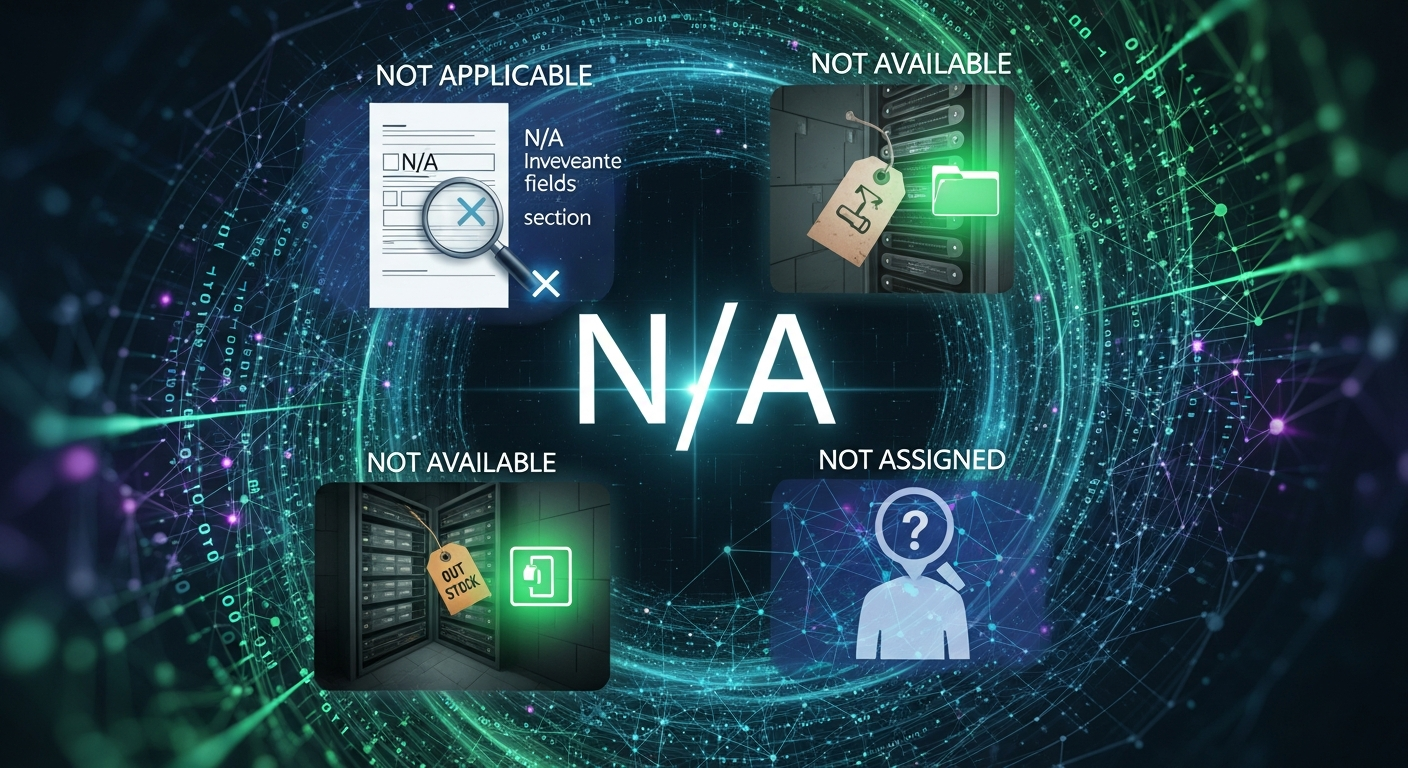
Our first big clue leads us to the most common secrets that N/A holds. It usually means three important things: “not applicable,” “not available,” or “not assigned.” Think of it like a secret agent with three different disguises, each one perfect for a different mission!
Let’s break down each disguise:
- “Not Applicable”: Imagine you’re filling out a form about pets. One question asks, “What kind of car does your pet drive?” That sounds silly, right? Pets don’t drive cars! So, you wouldn’t answer with “a red car” or “a big truck.” Instead, you’d write N/A. This tells everyone, “Hey, this question just doesn’t make sense for my pet! It doesn’t apply to this situation.” It’s a smart way of saying, “This question is not for me!”
- Picture this: Your teacher gives you a special permission slip for a field trip to a cool museum. One question asks, “Do you need a special car seat for your baby?” But you’re a big kid, not a baby, and you don’t have a baby going with you! So, for that question, you would write N/A. It’s polite, clear, and lets everyone know that this part of the form just doesn’t fit your situation.
- Another example: Let’s say you’re filling out a form about what kind of sports you play. There’s a question that says, “What is your football team’s captain’s name?” But what if you don’t play football? What if you play basketball instead? Then that question simply isn’t “applicable” to you. You’d proudly write N/A, showing that you understand the question, but it just doesn’t fit your personal sports story! This is a super common reason to see N/A on all sorts of papers and forms that grown-ups have to fill out. It saves time and prevents wrong answers!
- “Not Available”: This one is like when you really want a certain toy, but when you go to the store, a sign says, “Toy X: Not Available.” It means the toy isn’t there right now, or maybe it’s all sold out! In the world of information, N/A means the information just isn’t there to be found or used. It’s missing, like a puzzle piece that vanished!
- Imagine you’re a super detective looking for clues. You find a secret map, but one part of the map is torn off, and the treasure’s location is N/A – not available! You can’t find it because the information is missing.
- Think about a weather report. Sometimes, a weather report might say the temperature for a faraway mountain is N/A. This could be because there’s no weather station way up there to measure it, or maybe the station broke down. The information is simply “not available” for us to see.
- Or maybe you’re playing an online game. You look at your friend’s profile, and it says their “favorite rare item” is N/A. This might mean they haven’t found a rare item yet, or they haven’t told the game what their favorite one is. The information isn’t there for you to see; it’s “not available.”
- “Not Assigned”: This is a bit like when you have a classroom full of chairs, but some chairs haven’t been given to a specific student yet. They are “not assigned.” In the world of data, it means a piece of information simply hasn’t been given a label, a name, or put into a category. It’s waiting to be given a job, but it hasn’t been yet!
- Let’s say a big famous robot company is building new robots. They are all ready, but they haven’t been given their special robot names yet. On a list, their names would be N/A because a name hasn’t been “assigned” to them yet.
- Think about a list of tasks for a team. If one task says “Who is responsible? N/A,” it means no one has been chosen or “assigned” to do that task yet. It’s an open spot!
So, you see, N/A is incredibly versatile! It’s like a language of its own, giving us very clear information even when information is missing or irrelevant. It’s truly a clever little abbreviation!
Where Does N/A Live? Its Favorite Hiding Spots!
Now that we know what N/A means, let’s explore its most common habitats. Where do these mysterious letters show up the most? You’ll find them in three main places, like three different cities where N/A likes to visit:
City 1: Forms and Questionnaires – The Land of Personal Details!
This is probably where you’ve seen N/A the most! Think of any paper where you have to fill in bubbles or write answers. When a question simply doesn’t relate to you, that’s when “not applicable” comes to the rescue.
- Imagine a school survey: It asks about your favorite lunch, your favorite subject, and then, “What brand of baby food do you prefer?” Well, you’re not a baby, so that question doesn’t apply! You’d put N/A. It’s a polite and super clear way to skip questions that aren’t meant for you.
- Another example: When grown-ups sign up for things, like a new phone plan or a library card, they might get asked about things like “Do you own a car?” If they don’t, they’ll put N/A under questions about their car’s license plate or model. It helps keep the forms neat and only filled with important information. It stops people from making up answers just to fill a space!
City 2: Data Analytics and Reports – The World of Numbers and Information!
This is where N/A gets really interesting, especially for grown-ups who study lots of numbers and information (this is called “data analytics”). Here, N/A mostly means “Not Assigned” or “Not Available.” It pops up when information is missing from a computer’s records.
- Think of it like a giant treasure map: You’re trying to find out how many people clicked on a special button on a website. But sometimes, for some people, the computer didn’t record their click properly. Or maybe they clicked so fast the computer missed it! When the computer tries to make a report, it sees those missing clicks and writes N/A. It means the information about that click is “not available.”
- Privacy is a big deal! Sometimes, N/A shows up because of privacy rules. For example, if you use a new phone or computer, it might hide your exact location to protect your privacy. So, if someone tries to see exactly where you are from their data, it might just say N/A because that information is “not available” to keep your secrets safe! It’s like a secret shield for your information!
- Imagine you’re tracking how many different kinds of snacks people like. You have a list: Apples, Bananas, Oranges, Grapes. But some people just wrote “Fruit” without saying which fruit. So, for those entries, the specific fruit name would be N/A because it wasn’t “assigned” to a particular fruit on your list. This helps grown-ups know that some information is missing and they might need to ask for more details next time.
City 3: General Usage – The Everyday Explorer!
N/A is a busy abbreviation! Besides the main three, it can also have other meanings, like a super-spy with even more disguises!
- Sometimes, N/A can mean “no account,” like when someone doesn’t have a bank account.
- It can also mean “non-assessable,” which is a fancy way of saying something can’t be judged or measured.
- It might mean “not attested,” if something hasn’t been officially proven.
- “Not approved” is another one, meaning something didn’t get the thumbs up.
- In restaurants, if you see N/A next to a drink, it might mean “nonalcoholic” – a drink without alcohol.
- As a noun (like a “thing”), it can even stand for “no answer” or “nothing added.”
Isn’t that amazing? Such a small abbreviation can carry so many different messages! It’s like a master of disguise, always ready to tell you something important.
The Mystery Deepens: Why Does N/A Happen in Computer Data?
In the exciting world of computers and data (City 2), N/A isn’t just a random guest; it appears for very specific reasons. If you’re curious how these missing pieces impact advanced systems, you can explore The Mysterious Case of N/A: Unlocking Its Secrets in the World of AI! Think of it like a computer’s way of saying, “Oops, something went wrong here, or I don’t have all the pieces!”
Here are the top three reasons why N/A might show its face in computer reports, like clues for a detective:
- Incorrect Tagging or Missing Properties: Imagine you’re playing a game where you collect different kinds of items: swords, shields, and potions. Each item needs a “tag” to say what it is. If someone forgets to put the “sword” tag on a sword, or if the tag breaks off, then the computer looks at that item and says, “Hmm, no tag! This item’s type is N/A!” It’s like the computer doesn’t know what kind of item it is because the information (the tag) is missing or wrong.
- For example, if a website wants to know the “page title” for every page you visit, but some pages don’t have a title, then for those pages, the “page_title” information will be N/A. The computer can’t tell you something that wasn’t properly labeled or provided.
- Irrelevant Data for Event Types: This one is a bit like asking a fish to climb a tree. Fish are great at swimming, but climbing a tree isn’t “relevant” to what they do! In computer talk, if a computer is trying to find information that doesn’t make sense for a certain “event” (something that happened), it will show N/A.
- Let’s say a computer is recording every time someone clicks on a “play video” button. This is called a “click event.” But what if the computer also recorded someone just looking at a “page display” (just opening a page)? If you then try to find “click data” for that “page display” event, there won’t be any! So, the computer says the “click data” is N/A for that specific “page display” event because it’s not even supposed to have click data! It’s like trying to find an umbrella in a sunny desert – it’s just not relevant there!
- Privacy Issues Preventing Data Collection: This is a super important reason, like a secret bodyguard protecting your personal information. Sometimes, laws or special settings on your phone or computer stop information from being collected to protect your privacy.
- Remember when we talked about your location? If your phone has a setting that says, “Don’t share my location,” then when a computer tries to find out where you are, it won’t be able to! It will show N/A instead. This is great for keeping your secrets safe! A famous example is when new phone updates, like iOS 15, started hiding people’s IP addresses (which can sometimes show your general location). So, for those people, their exact location data becomes N/A – it’s hidden for their protection!
So, N/A in data isn’t just a mistake; it’s a signal! It tells us that something is missing, doesn’t fit, or is being kept private, which is incredibly helpful for people who work with lots of information.
Grown-Ups and N/A: How Do They Handle the Missing Pieces?
Since N/A can pop up so often in computer data, grown-ups who work with this information have clever ways to manage it. It’s like having special tools to deal with those missing puzzle pieces!
Here are three main ways they handle N/A in their reports:
- Apply Filters Like “Not Empty”: Imagine you have a box of toys, but some of the toys are broken. If you only want to play with the good, unbroken toys, you’d use a “filter” to take out all the broken ones. In computer reports, if grown-ups only want to see complete information and don’t want the N/A values messing up their view, they can apply a “Not empty” filter. This tells the computer, “Show me everything EXCEPT the N/A stuff!” It helps them focus on the information that is there.
- Disable “Show N/A Rows”: Sometimes, grown-ups just want to ignore the N/A parts for a moment. It’s like when you’re reading a book and you skip a paragraph because it’s not important to the main story right now. In computer reports, they can simply tell the computer, “Don’t show me any rows where the information is N/A.” The N/A information is still there, but it’s hidden from view, making the report look cleaner and easier to read.
- Review and Correct Tagging Configurations: This is the most important step for fixing the problem from the start! Remember our example of the missing sword tags? This strategy is all about making sure that the tags are put on correctly before the information is even collected. Grown-ups will check their computer systems to make sure that everything is being labeled properly and that no important information is being left out by mistake. It’s like double-checking that all the treasure chest keys are working before you go on a treasure hunt! By fixing these things, they can make sure fewer N/A values appear in the future.
These strategies show that N/A isn’t just a dead end; it’s often a sign that something can be improved or that data needs to be viewed in a certain way. It’s a helpful signal for making better decisions!
More N/A Secrets: The Un-Slashed Version and a Pinch of Science!
Hold on, our N/A adventure isn’t over yet! There’s another twist in the tale! Sometimes, you might see the letters NA without the slash. This is like N/A’s cousin, and it has even more meanings!
- North America: This is a big continent where countries like the USA, Canada, and Mexico are found. So, NA can stand for “North America”!
- National Army: This refers to the army of a country.
- Narcotics Anonymous: This is a special group that helps people.
- National Association: This means a big group or club that is for a whole country.
- And here’s a super cool one: In science, Na (without any slash, and with a small ‘a’) is the chemical symbol for sodium! Sodium is a special element, and you find it in common table salt. So, if you see Na in a science book, it’s probably talking about salt! This meaning comes from a very old Latin word called natrium.
Isn’t it amazing how just two letters can mean so many different things depending on how they’re written and where you see them? It’s like a secret code within a secret code!
The Journey of N/A: From Ancient Words to Global Talk!
Where did the idea of N/A even come from? Like all good mysteries, we can trace it back through time!
- The idea for “not applicable” comes from a very old language called Latin. The Latin words non applicabilis mean exactly what “not applicable” means today. So, this helpful idea has been around for a very, very long time!
And it’s not just in English! People all over the world use the idea of N/A, even if they say it differently:
- In Chinese, they might say “不適用” (bù shì yòng), which means “not applicable.”
- In Spanish, they often use “n/a” too, or say “no pertinente.”
- In French, you’d hear “ne s’applique pas.”
- And in Japanese, it’s “該当なし” (gaitou nashi).
So, no matter where you go in the world, the important message that N/A carries – that something is missing or doesn’t fit – is understood by everyone! It’s a truly global language of clarity!
The Big Impact of N/A: Why It Matters So Much!
You might think N/A is just a tiny detail, but it actually has a huge impact, especially when grown-ups are trying to understand big sets of numbers.
- Skewing Totals (But Not Always!): Imagine you’re counting how many students in your class like apples. You ask everyone, but two students were absent and couldn’t answer. For those two, their answer would be N/A. If you just count the answers you did get, your total for “apple lovers” might seem lower than it actually is because you didn’t hear from everyone. This is what we mean by “skewing totals” – the N/A values can make your results look a bit off because they leave out some information.
- But Here’s the Clever Part! Even if some specific answers are N/A, the overall totals for big things usually stay correct. For example, if you’re counting how many times people visited a website, even if you don’t know what page they visited every single time (some page titles might be N/A), you still know the total number of visits. The computer still counts each visit only once for the total number of visits, even if some details are missing. It’s like knowing you have 10 toys, but some are in a mystery box labeled N/A. You know you have 10 toys, even if you don’t know exactly what those mystery toys are yet!
This is why understanding N/A is so crucial! It helps people make smart decisions by knowing exactly what information they have, what they don’t have, and why.
The Grand Conclusion: N/A, Our Everyday Hero!
Wow! What an incredible journey we’ve had, uncovering the many secrets and meanings of N/A! From simple forms to complex computer data, and even across different languages, this humble abbreviation plays a vital role in helping us understand information and communicate clearly.
We’ve learned that N/A isn’t just a sign of something missing; it’s a powerful messenger that tells us when something is “not applicable,” “not available,” or “not assigned.” It protects our privacy, helps grown-ups analyze data, and makes sure we don’t try to answer questions that don’t make sense for us.
So, the next time you spot those two little letters, N/A, remember the thrilling adventure we had today. You’ll no longer see a mystery; you’ll see a clever code, a helpful friend, and a powerful tool that makes our world of information clearer and more understandable. You are now an N/A expert, ready to explain its fascinating story to anyone who asks! Isn’t that exciting?! The secret code is no longer a secret, and you’re in on it!
Frequently Asked Questions
What are the three main meanings of N/A?
The three main meanings of N/A are “not applicable,” “not available,” and “not assigned.” Each meaning helps communicate clearly when information is missing, irrelevant, or not yet set.
Why do we often see N/A in forms?
In forms, N/A is primarily used to indicate “not applicable.” This allows you to politely and clearly skip questions that do not relate to your specific situation or details, preventing the need to provide irrelevant or made-up answers.
How does N/A help with data privacy?
N/A can appear in data reports due to privacy issues preventing data collection. This means that certain information, like your exact location or IP address, might be deliberately hidden or blocked by privacy settings or laws, making that data “not available” to protect your personal information.
What does NA (without a slash) mean in different contexts?
While N/A (with a slash) has specific meanings, NA (without a slash) can refer to many other things, such as North America, National Army, Narcotics Anonymous, National Association, or even the chemical symbol for sodium (Na) in science.
How do grown-ups manage N/A values in computer reports?
Grown-ups handle N/A in computer reports in several ways: they can apply “Not Empty” filters to focus on complete data, disable “Show N/A Rows” to clean up reports, and most importantly, review and correct tagging configurations to prevent N/A values from appearing in the first place.